
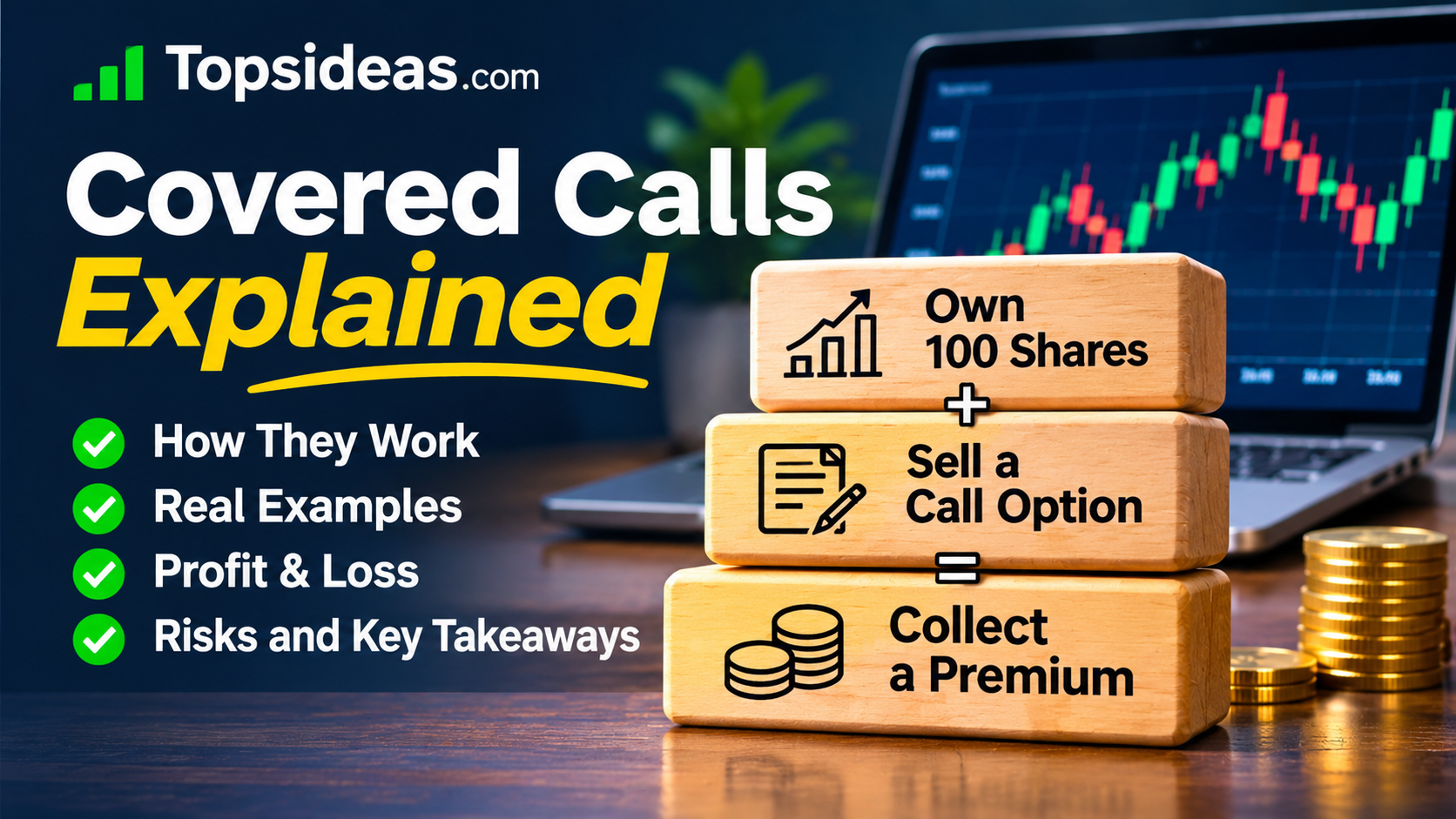

A beginner-friendly guide to generating options premiums, understanding assignment, and managing risk.
Covered calls explained: A covered call is an options strategy that allows investors to collect a premium by selling call options against shares they already own. In exchange, they agree to sell those shares at a predetermined strike price if assigned. This guide explains how covered calls work, with practical examples, profit calculations, assignment scenarios, and important risks for U.S. investors.
The strategy may appeal to investors seeking additional cash flow from existing stock holdings. However, covered calls are not guaranteed income, and they do not protect investors from substantial stock market losses.
In this guide, we’ll explain how covered calls work, walk through a realistic numerical example, calculate potential profits and losses, and explore the risks every investor should understand.
What Is a Covered Call?
A covered call is an options strategy that combines two positions:
- Owning at least 100 shares of a stock.
- Selling one standard call option contract against those shares.
For most standard U.S. equity options, one contract represents 100 shares.
When you sell a call option, the buyer receives the right, but not the obligation, to purchase your shares at a specified price, known as the strike price, on or before the option’s expiration date.
In return, you receive an option premium.
Because you already own the shares needed to fulfill the contract, the call is considered covered.
Important terms to understand
- Premium: The amount received for selling the option.
- Strike price: The price at which you may be required to sell your shares.
- Expiration date: The date the option contract expires.
- Assignment: When the option seller must fulfill the contract’s obligations.
- In the money (ITM): For a call option, when the stock price is above the strike price.
- Out of the money (OTM): For a call option, when the stock price is below the strike price.
How Does a Covered Call Work?
Imagine you own 100 shares of a company trading at $50 per share.
Your stock position is worth:
100 shares × $50 = $5,000
You decide to sell one call option with the following terms:
| Item | Value |
|---|---|
| Stock price | $50 |
| Shares owned | 100 |
| Stock purchase price | $50 per share |
| Call strike price | $55 |
| Time to expiration | 30 days |
| Option premium | $2 per share |
| Total premium received | $200 |
This is a hypothetical example for educational purposes. It is not a live options quote.
Since one contract represents 100 shares, selling the call generates:
$2 × 100 = $200 in premium
You receive the $200 when the option is sold, before commissions and fees.
However, the premium is not automatically your final profit. The value of the stock can change, and you may have to sell the shares if the option is assigned.
Three Possible Outcomes at Expiration
Let’s examine what happens under three different stock price scenarios.
Scenario 1: The Stock Stays Below $55
Suppose the stock finishes at $52 on expiration day.
The $55 call is out of the money and would ordinarily expire worthless if it remains out of the money through expiration.
You keep:
- Your 100 shares.
- The $200 premium received.
Your shares have also increased in market value by $200 compared with the original $50 purchase price.
Total economic gain: $400
This consists of a $200 unrealized stock gain and $200 in option premium, before expenses and taxes.
You could consider selling another covered call, but future premiums are not guaranteed.
Scenario 2: The Stock Rises Above $55
Now suppose the stock finishes at $60.
The call is in the money. Assuming the option is exercised and assigned, you must sell your 100 shares at $55 each, even though the market price is $60.
Your stock profit is:
($55 − $50) × 100 = $500
You also received $200 in option premium.
Total profit: $700
The trade produces a $700 profit before fees and taxes, but you give up additional upside above the strike price.
If you had simply held the 100 shares without selling a call, their gain at $60 would have been $1,000.
The covered call therefore earns $300 less than simply holding the stock in this scenario.
Scenario 3: The Stock Falls to $40
Suppose the stock declines to $40.
The $55 call would ordinarily expire worthless, so you keep the $200 premium.
However, your shares have lost:
($50 − $40) × 100 = $1,000
After accounting for the premium:
Net economic loss: $800
The premium reduces the loss, but it does not eliminate the downside risk.
This is one of the most important limitations of covered calls: a falling stock can lose much more value than the premium received.
Covered Call Profit and Loss Table
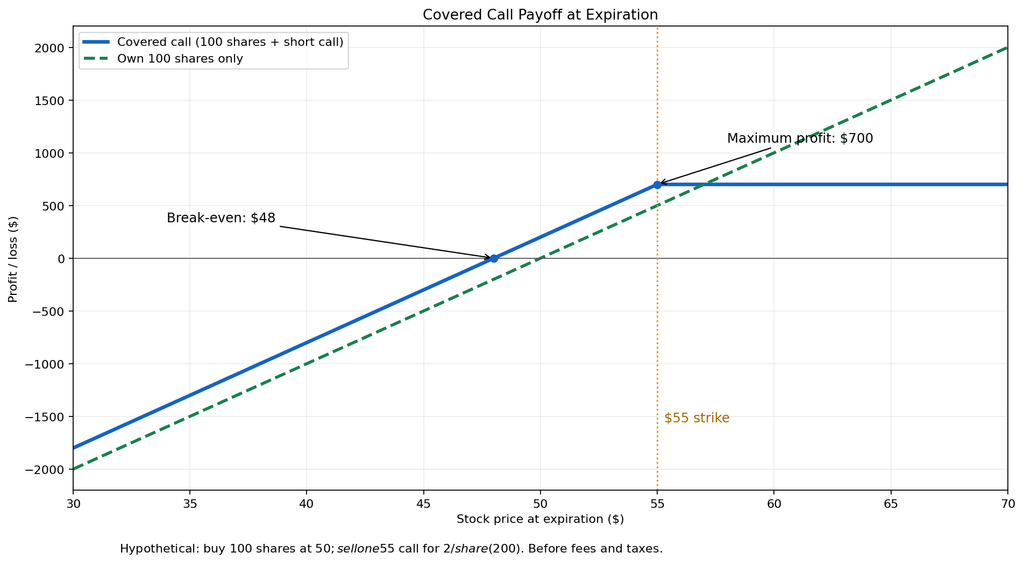
Using the same example, here’s how the position performs at different stock prices at expiration.
| Stock price at expiration | Stock profit/loss | Call payoff to seller | Premium received | Total profit/loss |
|---|---|---|---|---|
| $30 | −$2,000 | $0 | +$200 | −$1,800 |
| $40 | −$1,000 | $0 | +$200 | −$800 |
| $45 | −$500 | $0 | +$200 | −$300 |
| $50 | $0 | $0 | +$200 | +$200 |
| $52 | +$200 | $0 | +$200 | +$400 |
| $55 | +$500 | $0 | +$200 | +$700 |
| $60 | +$1,000 | −$500 | +$200 | +$700 |
| $70 | +$2,000 | −$1,500 | +$200 | +$700 |
The table assumes the shares were purchased at $50, the call was sold for $2 per share, the position is evaluated at expiration, and there are no commissions, taxes, or early-assignment effects.
Notice that profits stop increasing once the stock rises above $55.
The short call offsets any additional gains in the underlying shares.
What Is the Maximum Profit on a Covered Call?
The maximum profit is limited because the investor has agreed to sell the shares at the strike price.
For a covered call established by buying shares and selling a call at the same time:
Maximum profit = (Strike price − Stock purchase price + Premium received per share) × 100
Using our example:
($55 − $50 + $2) × 100 = $700
Therefore, the maximum profit is $700 before fees and taxes.
This calculation assumes one standard option contract covering 100 shares.
For an investor who already owns stock, the same calculation can be made using the actual share purchase price, although the original purchase price may differ substantially from the stock’s current market value.
What Is the Break-Even Price?
The break-even price is the stock price at expiration where the combined stock-and-option position has no overall profit or loss.
Break-even price = Stock purchase price − Premium received per share
In our example:
$50 − $2 = $48
If the stock finishes at $48, the $200 loss on the shares is offset by the $200 option premium.
Below $48, the overall position loses money.
This break-even figure applies to the complete stock-plus-call position, not to the short call considered separately.
Can You Lose Money Selling Covered Calls?
Yes.
Although covered calls are sometimes described as income strategies, investors can experience substantial losses.
If the stock falls to zero, the shares become worthless. The premium provides only limited protection.
In our example:
- Initial stock investment: $5,000
- Premium received: $200
- Maximum potential loss: $4,800
The investor can lose nearly the entire original investment.
Covered calls should not be confused with risk-free interest payments or guaranteed dividend income.
How to Choose a Covered Call Strike Price
Choosing the strike price is one of the most important decisions in the strategy.
Out-of-the-Money Calls
An out-of-the-money call has a strike price above the current stock price.
For example, if a stock trades at $50, a $55 call is out of the money.
These calls generally offer more room for stock appreciation before assignment becomes economically attractive, but they often generate smaller premiums than comparable at-the-money calls.
At-the-Money Calls
An at-the-money call has a strike price close to the current stock price.
These options often provide more premium than otherwise comparable out-of-the-money calls, but they also limit additional stock appreciation sooner.
In-the-Money Calls
An in-the-money call has a strike price below the current stock price.
These calls contain intrinsic value and may provide a larger total premium, but the investor has a greater likelihood of assignment, all else equal.
A higher premium does not necessarily mean a better investment outcome.
Understanding Delta When Selling Covered Calls
Options traders frequently use delta when evaluating call options.
Delta estimates how much an option’s price may change for a $1 move in the underlying stock, holding other factors approximately constant.
For example, a call with a delta of 0.30 may increase in value by approximately $0.30 for a $1 increase in the stock price, for a small move under otherwise unchanged conditions.
Some traders use call delta as a rough indication of the likelihood of finishing in the money.
However, delta is not a precise probability of assignment, and its interpretation depends on the pricing model and market conditions.
A 0.30-delta call does not guarantee a 30% assignment probability.
Investors should also consider implied volatility, expiration, dividends, liquidity, and their willingness to sell the underlying shares.
Weekly vs. Monthly Covered Calls
Covered calls can be written with different expiration dates.
Weekly Covered Calls
Potential advantages:
- More frequent opportunities to select new strikes.
- Shorter periods before an option expires.
- Flexibility to respond to changing stock prices.
Potential disadvantages:
- More frequent trading decisions.
- Transaction costs can accumulate.
- Greater exposure to short-term price movements and assignment management.
Monthly Covered Calls
Potential advantages:
- Less frequent trading activity.
- More time between position adjustments.
- Potentially larger premium per contract than a comparable shorter-dated option.
Potential disadvantages:
- Capital and shares remain committed for longer unless the option is closed.
- Market conditions can change significantly before expiration.
- Assignment and opportunity costs remain.
Neither weekly nor monthly covered calls are automatically more profitable.
Comparisons should account for risk, premium received, volatility, commissions, and the investor’s objectives.
What Happens If Your Covered Call Gets Assigned?
Assignment means the option seller must fulfill the contract.
For a standard U.S. equity call, that generally means delivering 100 shares at the strike price.
If you sell a $55 covered call and are assigned, your broker sells the covered shares for $55 each.
You retain the original premium, but you no longer own those shares.
You may miss further appreciation if the stock continues rising.
Can assignment happen before expiration?
Yes.
Most standard U.S. equity options are American-style and can be exercised before expiration.
Early assignment is especially relevant when an in-the-money call approaches a stock’s ex-dividend date and the remaining time value is small relative to the dividend.
Assignment can also occur for other reasons.
Investors should not assume that an out-of-the-money option will always expire without complications or that an in-the-money option can only be assigned on expiration day.
Can You Close a Covered Call Before Expiration?
Yes.
After selling a call, you can generally buy back the same option to close the short call position.
For example:
- You initially sell a call for $2.00 per share, receiving $200.
- Later, the option trades at $0.40 per share.
- You buy it back for $40.
Your realized profit on the option leg is:
$200 − $40 = $160
This is before commissions and fees and excludes changes in the underlying stock.
Closing the option removes the obligation associated with that short call, provided the closing transaction is completed before assignment.
You can then decide whether to hold your shares without a call or sell another option.
However, if the option rises in price, buying it back may cost more than the premium originally received.
What Does Rolling a Covered Call Mean?
Rolling involves closing an existing short call and selling another call, often with a later expiration date or a different strike price.
For example, an investor might buy back a $55 call and sell a $60 call expiring the following month.
Rolling may provide additional upside room or extend the position, but it does not erase a loss.
The cost of closing the original option and the premium from the new option must both be considered.
A roll can result in a net credit or a net debit.
It also creates a new obligation with its own risks.
Are Covered Calls Better Than Dividends?
Covered call premiums and dividends are different.
Dividends are distributions made by a company to eligible shareholders. Covered call premiums are payments received in exchange for taking on an options obligation.
Dividends depend on corporate decisions and financial conditions. Options premiums depend on market pricing, including volatility, strike price, and time to expiration.
Covered call premiums are not guaranteed recurring income, and they should not be treated as equivalent to dividend payments.
Selling covered calls can also cause an investor to lose shares before an ex-dividend date, potentially affecting dividend eligibility.
Tax Considerations for U.S. Investors
Covered call taxation can be more complicated than simply treating every premium as immediate taxable income.
The tax treatment may depend on whether the option expires, is closed, or is exercised.
For example:
- If a written call expires unexercised, the premium generally produces a short-term capital gain.
- If the writer closes the call, the difference between the premium received and the closing cost generally determines the short-term gain or loss.
- If the call is exercised, the premium generally affects the amount realized from selling the underlying shares.
Special rules for qualified covered calls, holding periods, and straddles may also apply.
Investors should consult IRS Publication 550 and a qualified tax professional for guidance relevant to their circumstances.
Common Covered Call Mistakes
1. Choosing a Stock Only Because Its Premium Is High
High option premiums may reflect significant expected volatility or company-specific risks.
A stock can decline much more than the premium received.
2. Selling Calls at a Strike Price You Would Regret
Before selling a covered call, ask yourself:
Would I be comfortable selling my shares at this strike price?
If the answer is no, the selected strike may not align with your investment objectives.
3. Ignoring Earnings Announcements
Stock prices can move sharply following quarterly earnings reports.
An unexpectedly strong report may cause the stock to rise far beyond the strike price, limiting the covered call investor’s upside.
A disappointing report may lead to stock losses that outweigh the premium.
4. Assuming the Premium Is Guaranteed Profit
Receiving a premium does not guarantee that the combined position will be profitable.
The underlying stock’s performance is essential to the final outcome.
5. Ignoring Early Assignment and Dividends
Short calls may be assigned before expiration, especially around ex-dividend dates.
Investors should monitor their positions and understand their broker’s assignment procedures.
6. Repeatedly Rolling Without Evaluating the Economics
Rolling a losing call does not make the previous loss disappear.
Every adjustment should be evaluated as a new financial decision.
Who Might Consider Covered Calls?
Covered calls may be appropriate for investors who:
- Already own at least 100 shares of a stock.
- Have a neutral to moderately bullish outlook.
- Are willing to sell their shares at a chosen strike price.
- Understand that the premium provides only limited downside protection.
- Can monitor options positions and manage assignment risk.
They may be less suitable for investors who expect substantial stock appreciation, cannot tolerate stock losses, or are unwilling to sell their shares.
Options trading also requires brokerage approval and an understanding of the relevant risks.
Frequently Asked Questions
Can you make money selling covered calls every week?
You may collect premiums from repeatedly selling weekly calls, but consistent profits are not guaranteed. Stock losses, assignment, transaction costs, and the cost of closing options can outweigh the premiums received.
Do you need 100 shares to sell a covered call?
For one standard U.S. equity call option contract, you generally need 100 shares. Adjusted options and certain other products can have different contract specifications.
What happens if a covered call expires worthless?
If the call expires unexercised, the seller keeps the premium and generally retains the underlying shares. The stock’s price may still have increased or decreased during the option’s life.
Is selling a covered call bullish or bearish?
Covered calls are generally considered neutral to moderately bullish strategies. They can benefit from a stable or moderately rising stock price but limit gains above the strike price.
Can you sell covered calls on ETFs?
Yes, options are available on many exchange-traded funds. Investors should check contract specifications, liquidity, and exercise rules because some options products differ from standard equity options.
Can you lose your shares when selling covered calls?
Yes. If assigned, you must deliver the covered shares at the strike price. This is a central feature of the strategy.
Is a covered call safer than owning stock?
The premium reduces the position’s break-even price and provides a limited cushion against losses. However, the investor remains exposed to substantial downside risk and gives up some potential upside.
Final Thoughts: Are Covered Calls Worth It?
Covered calls can be a useful strategy for investors who already own stocks and are willing to sell those shares at predetermined prices.
They allow investors to collect option premiums, but those premiums come with trade-offs.
The investor accepts limited upside potential, assignment risk, and continued exposure to stock price declines.
The most important principle is simple:
A covered call should be evaluated as a complete stock-and-options position, not merely as a way to collect premiums.
Before using the strategy, investors should understand the maximum profit, break-even price, downside exposure, expiration mechanics, and potential tax consequences.
Further Reading and Sources
- Options Industry Council — Options Education
- OCC — Characteristics and Risks of Standardized Options
- IRS Publication 550 — Investment Income and Expenses
- Investor.gov — U.S. Securities and Exchange Commission
Financial Disclaimer: This article is provided by Topsideas for educational and informational purposes only. It does not constitute personalized investment, financial, tax, or legal advice, or a recommendation to buy or sell any security or options contract. Options involve risk and are not suitable for all investors. Examples are hypothetical and exclude commissions, fees, and taxes unless otherwise stated. Investors should review the OCC’s Characteristics and Risks of Standardized Options before trading and consult appropriately qualified professionals when needed.
