


How do you calculate a cryptocurrency’s price from its market cap? Divide the target market capitalization by the number of circulating coins or tokens.
For example, if a cryptocurrency reaches a $10 billion market cap with 2 billion tokens in circulation, its implied price would be $5 per token.
This simple formula can help investors answer questions such as:
- What would a cryptocurrency be worth at a $1 billion market cap?
- How much could a token cost at a $10 billion valuation?
- Why can one cryptocurrency trade at $0.01 while another trades at $1,000?
- How do token unlocks and increasing supply affect price?
- What’s the difference between market cap and fully diluted valuation (FDV)?
In this guide, you’ll learn how to calculate cryptocurrency market capitalization, estimate hypothetical token prices, compare valuations, and understand why circulating supply matters.
All calculations use hypothetical figures for educational purposes. They are not price forecasts.
What Is Crypto Market Cap?
Cryptocurrency market capitalization, commonly called crypto market cap, measures the estimated market value of a cryptocurrency’s circulating supply.
It is calculated by multiplying the current market price of one token by the number of tokens circulating.
Crypto Market Cap = Token Price × Circulating Supply
For example, imagine a cryptocurrency with:
- Current token price: $2
- Circulating supply: 500 million tokens
Its market capitalization would be:
$2 × 500,000,000 = $1 billion
This means the cryptocurrency has an estimated circulating market capitalization of $1 billion.
Importantly, market capitalization does not mean that investors have deposited $1 billion into the project. It is a valuation derived from the prevailing token price and circulating supply.
The same principle is used by major crypto data platforms such as CoinGecko.
Crypto Market Cap Calculator: The Formula
There are three useful calculations investors should understand.
1. Calculate Market Capitalization
Market Cap = Token Price × Circulating Supply
Example:
$0.50 × 4 billion tokens = $2 billion market cap
2. Calculate Token Price From Market Cap
Token Price = Market Cap ÷ Circulating Supply
Example:
$10 billion ÷ 4 billion tokens = $2.50 per token
3. Calculate Circulating Supply
Circulating Supply = Market Cap ÷ Token Price
Example:
$3 billion ÷ $1.50 = 2 billion tokens
These formulas are mathematically straightforward. However, interpreting the results requires understanding how token supply changes.
How to Calculate Crypto Price From Market Cap: Step by Step
Let’s calculate the implied price of a hypothetical cryptocurrency at a $5 billion valuation.
Step 1: Find the Circulating Supply
Suppose a token has 1.25 billion coins circulating.
You can typically find circulating supply information on CoinGecko, CoinMarketCap, or a project’s official documentation.
Verify the reported supply when possible, because data providers may use different definitions or update schedules.
Step 2: Choose a Target Market Cap
Assume you want to estimate the token’s price if its market capitalization reaches $5 billion.
This is a hypothetical valuation, not a prediction.
Step 3: Apply the Formula
Token Price = $5,000,000,000 ÷ 1,250,000,000
The result is:
$4 per token
Step 4: Consider Future Token Supply
If circulating supply increases before the cryptocurrency reaches the target valuation, the implied price changes.
For example, with 2 billion circulating tokens instead of 1.25 billion:
$5 billion ÷ 2 billion = $2.50 per token
That’s why supply assumptions are essential when researching cryptocurrencies.
Crypto Price at Different Market Caps: Comparison Table
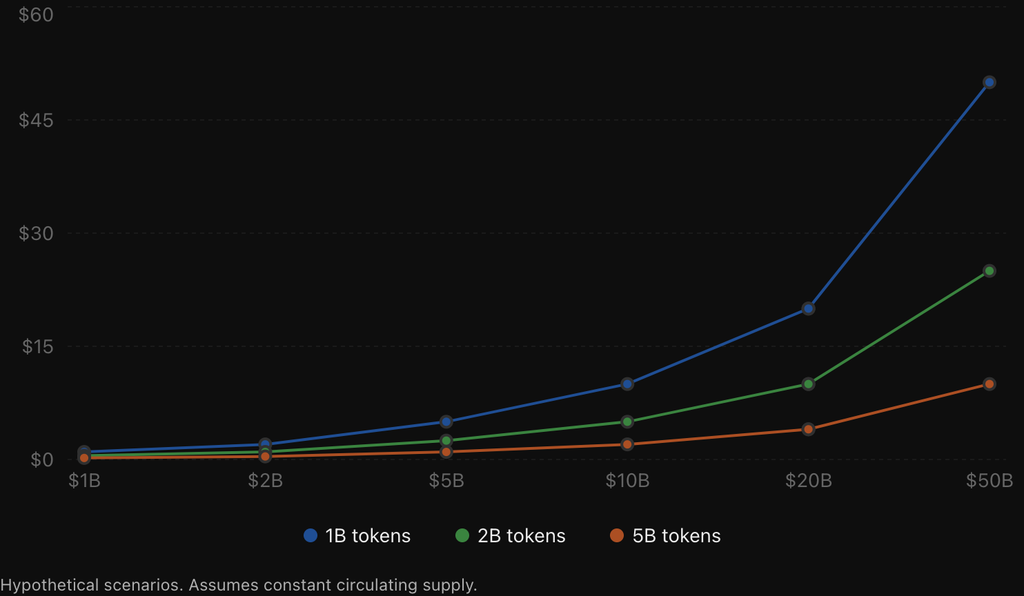
Consider a hypothetical cryptocurrency with 1 billion circulating tokens.
| Target market cap | Implied token price |
|---|---|
| $100 million | $0.10 |
| $250 million | $0.25 |
| $500 million | $0.50 |
| $1 billion | $1.00 |
| $2 billion | $2.00 |
| $5 billion | $5.00 |
| $10 billion | $10.00 |
| $25 billion | $25.00 |
| $50 billion | $50.00 |
| $100 billion | $100.00 |
The relationship is linear when circulating supply remains constant.
For example, increasing market capitalization from $5 billion to $10 billion doubles the implied token price from $5 to $10.
However, cryptocurrency prices do not necessarily increase in a smooth or predictable way.
Market sentiment, liquidity, supply changes, adoption, regulations, and other factors influence valuations.
What Would a Crypto Be Worth at a $1 Billion Market Cap?
The answer depends on circulating supply.
Two cryptocurrencies can have the same $1 billion market capitalization but dramatically different token prices.
| Circulating supply | Implied price at $1B market cap |
|---|---|
| 10 million | $100 |
| 50 million | $20 |
| 100 million | $10 |
| 500 million | $2 |
| 1 billion | $1 |
| 5 billion | $0.20 |
| 10 billion | $0.10 |
| 100 billion | $0.01 |
A token priced at $0.01 is not automatically undervalued.
It might have an enormous circulating supply.
Similarly, a cryptocurrency trading at $100 per token is not necessarily more valuable as a project than one trading at $1.
Market capitalization provides more context than token price alone.
What Would a Crypto Be Worth at a $10 Billion Market Cap?
A $10 billion market capitalization is a common hypothetical scenario investors use when evaluating growth opportunities.
Consider the following examples:
| Circulating supply | Implied price at $10B market cap |
|---|---|
| 50 million | $200 |
| 100 million | $100 |
| 250 million | $40 |
| 500 million | $20 |
| 1 billion | $10 |
| 2 billion | $5 |
| 5 billion | $2 |
| 10 billion | $1 |
| 100 billion | $0.10 |
For example, a cryptocurrency with 5 billion circulating tokens would have an implied price of $2 at a $10 billion market cap.
But if its circulating supply later increased to 10 billion tokens, the same market capitalization would imply a price of only $1.
This illustrates why market-cap targets must be evaluated alongside tokenomics.
What Is Circulating Supply in Cryptocurrency?
Circulating supply refers to the number of coins or tokens considered available in the public market.
It is different from total supply and maximum supply.
Understanding these distinctions is particularly important for newer cryptocurrency projects.
Circulating Supply
The number of tokens currently considered available for public trading under a data provider’s methodology.
Total Supply
The number of tokens that currently exist, generally excluding tokens permanently removed through burning.
Total supply may include locked tokens that are not yet circulating.
Maximum Supply
The maximum number of tokens that can exist under a cryptocurrency’s supply rules, if a maximum is defined.
Not every cryptocurrency has a fixed maximum supply.
Supply Comparison
| Supply metric | Meaning | Why investors examine it |
|---|---|---|
| Circulating supply | Tokens currently considered available | Used to calculate circulating market cap |
| Total supply | Existing tokens, including many noncirculating tokens | Helps identify potential future supply |
| Maximum supply | Maximum permitted supply, if defined | Provides context about long-term issuance limits |
Supply figures may change through token unlocks, issuance, burns, and protocol changes.
Crypto Market Cap vs. Fully Diluted Valuation (FDV)
One of the most important concepts in cryptocurrency valuation is fully diluted valuation, or FDV.
Circulating market cap uses tokens currently in circulation.
FDV estimates a valuation using a broader supply measure, typically total supply or maximum supply depending on the platform and token.
FDV = Current Token Price × Fully Diluted Supply Assumption
Consider a hypothetical cryptocurrency:
- Current token price: $2
- Circulating supply: 500 million tokens
- Maximum supply: 5 billion tokens
Its circulating market capitalization is:
$2 × 500 million = $1 billion
Using maximum supply, its fully diluted valuation would be:
$2 × 5 billion = $10 billion
| Metric | Value |
|---|---|
| Token price | $2 |
| Circulating supply | 500 million |
| Maximum supply | 5 billion |
| Circulating market cap | $1 billion |
| Maximum-supply FDV | $10 billion |
| FDV-to-market-cap ratio | 10× |
Only 10% of the maximum supply is circulating in this example.
This does not automatically mean the token is overvalued. However, it raises important questions about future issuance, unlock schedules, and potential selling pressure.
Investors should also verify which supply definition their chosen data platform uses for FDV.
How Token Unlocks Can Affect Cryptocurrency Prices
Token unlocks occur when previously restricted tokens become available according to a project’s vesting or distribution schedule.
These tokens may belong to investors, project teams, foundations, or ecosystem programs.
Unlocks can increase circulating supply.
Let’s examine a hypothetical scenario.
A cryptocurrency initially has:
- Market cap: $2 billion
- Circulating supply: 1 billion tokens
- Token price: $2
Suppose 500 million additional tokens enter circulation.
The new circulating supply becomes 1.5 billion tokens.
If market capitalization remains unchanged at $2 billion:
$2 billion ÷ 1.5 billion = approximately $1.33 per token
| Scenario | Circulating supply | Assumed market cap | Implied token price |
|---|---|---|---|
| Before unlock | 1 billion | $2 billion | $2.00 |
| After unlock | 1.5 billion | $2 billion | $1.33 |
Under the constant-market-cap assumption, the implied price decreases by approximately 33.3%.
Important: This is a mathematical scenario, not a prediction of the market reaction to an unlock.
Actual prices depend on demand, liquidity, investor behavior, whether unlocked tokens are sold, and other market conditions.
Some token unlocks may have little immediate price impact, while others can coincide with substantial volatility.
Can a Cryptocurrency Reach $1?
Investors frequently ask whether a cryptocurrency trading at a fraction of a cent can reach $1.
The relevant question is:
What market capitalization would the cryptocurrency need at $1 per token?
Suppose a cryptocurrency has 100 billion circulating tokens.
At $1 per token:
$1 × 100 billion = $100 billion market cap
Now suppose another cryptocurrency has only 100 million circulating tokens.
At $1 per token:
$1 × 100 million = $100 million market cap
The same $1 price target requires very different valuations.
That’s why a token’s low nominal price should never be the sole basis for an investment decision.
Can a Cryptocurrency Reach $10 or $100?
The same principle applies to higher price targets.
Suppose a cryptocurrency has 2 billion circulating tokens.
| Target token price | Required market cap |
|---|---|
| $0.50 | $1 billion |
| $1 | $2 billion |
| $2 | $4 billion |
| $5 | $10 billion |
| $10 | $20 billion |
| $25 | $50 billion |
| $50 | $100 billion |
| $100 | $200 billion |
For this cryptocurrency to trade at $100 while circulating supply remains at 2 billion, its market capitalization would need to reach $200 billion.
Whether such a valuation is plausible requires additional analysis.
Investors should evaluate the project’s actual utility, adoption, competitive position, token economics, and risks rather than relying on price targets alone.
Does Market Cap Tell You Whether a Crypto Is Undervalued?
Market capitalization is useful, but it does not determine whether a cryptocurrency is fairly valued.
For example, consider two hypothetical projects.
Project A
- Market cap: $500 million
- Limited adoption
- Large future token unlocks
- Weak liquidity
Project B
- Market cap: $2 billion
- Established usage
- More transparent token distribution
- Stronger liquidity
Project A has the lower market capitalization, but that does not necessarily make it the better investment.
Investors should examine additional factors, including:
- Token utility and demand.
- Network activity.
- Revenue or fees, where relevant.
- Circulating and future supply.
- Token ownership concentration.
- Liquidity and trading volume.
- Security risks.
- Governance and protocol design.
- Regulatory considerations.
Market capitalization is a starting point, not a complete valuation model.
Market Cap vs. Trading Volume vs. Liquidity
These three terms are often confused.
Market capitalization measures the estimated market value of circulating tokens.
Trading volume measures the value of transactions over a specified period, commonly 24 hours.
Liquidity describes how easily an asset can be bought or sold without materially affecting its price.
For example, a token might have a reported market capitalization of $1 billion but relatively limited liquidity.
In that situation, large orders could cause significant price changes.
A cryptocurrency’s market cap is therefore not equivalent to the amount of cash available to investors who want to sell.
Why Market Cap Doesn’t Equal Money Invested
Imagine a cryptocurrency with 1 billion circulating tokens trading at $1.
Its market cap is $1 billion.
If its price increases to $1.10 while supply remains constant, its market cap becomes $1.1 billion.
That is a $100 million increase in market capitalization.
However, this does not mean investors necessarily invested an additional $100 million.
Market cap is based on the prevailing price multiplied by supply. Changes in price can alter the implied valuation without an equivalent amount of net money entering or leaving the market.
This distinction is particularly important for tokens with limited liquidity.
How to Research a Cryptocurrency’s Market Cap
Before calculating hypothetical future prices, follow this research process.
Step 1: Verify the Cryptocurrency
Confirm the token’s official name, ticker, blockchain, and contract address where applicable.
Different projects can have similar names or symbols.
Step 2: Find Current Market Data
Use a reputable crypto data provider to review price, circulating supply, market cap, and trading volume.
Step 3: Review Tokenomics
Check the project’s official documentation for maximum supply, issuance schedules, token allocation, and vesting.
Step 4: Compare Market Cap and FDV
A large gap may indicate that substantial supply has yet to enter circulation.
Step 5: Create Multiple Valuation Scenarios
Calculate implied prices under several target market caps rather than relying on a single optimistic assumption.
Step 6: Account for Supply Changes
Repeat the calculations with different future circulating-supply estimates.
Step 7: Evaluate the Risks
Market capitalization calculations do not account for hacks, liquidity crises, regulatory developments, project failures, or changes in investor demand.
Common Crypto Market Cap Calculation Mistakes
Mistake 1: Ignoring Circulating Supply
A token’s price alone tells you very little about its overall valuation.
Mistake 2: Confusing Market Cap With FDV
A project can have a relatively small circulating market cap and a much larger fully diluted valuation.
Mistake 3: Assuming Supply Will Stay Constant
New issuance and token unlocks can change the number of circulating tokens.
Mistake 4: Comparing Unrelated Projects Only by Market Cap
Different blockchains and token types can have different economic functions and risks.
Mistake 5: Treating Implied Prices as Predictions
A calculator can determine the price associated with an assumed market cap. It cannot establish whether that valuation will occur.
Mistake 6: Ignoring Liquidity
A large reported market cap does not guarantee that investors can sell large positions near the displayed market price.
Frequently Asked Questions About Crypto Market Cap
How Do You Calculate Crypto Market Cap?
Multiply the current token price by circulating supply.
For example, a token trading at $2 with 500 million circulating tokens has a $1 billion market cap.
How Do You Calculate Crypto Price From Market Cap?
Divide market capitalization by circulating supply.
For example, $5 billion divided by 1 billion tokens equals $5 per token.
What Would a Crypto Be Worth at a $1 Billion Market Cap?
With 1 billion circulating tokens, its implied price would be $1. With 100 million circulating tokens, it would be $10.
What Would a Crypto Be Worth at a $10 Billion Market Cap?
With 2 billion circulating tokens, the implied price would be $5. With 10 billion tokens, it would be $1.
Is a Low Market Cap Cryptocurrency a Good Investment?
Not necessarily. Lower market-cap cryptocurrencies may offer substantial growth potential, but they can also carry elevated volatility, liquidity, and project-specific risks.
Is a $0.01 Cryptocurrency Cheap?
Not necessarily. A $0.01 token with 100 billion circulating tokens already has a $1 billion market capitalization.
What Is Fully Diluted Valuation in Crypto?
FDV estimates the value of a cryptocurrency using a broader token supply assumption, commonly total or maximum supply, multiplied by the current token price.
Can Token Unlocks Reduce Crypto Prices?
Token unlocks can increase circulating supply and create potential selling pressure, but the actual price effect depends on market conditions and investor behavior.
Does Crypto Market Cap Include Locked Tokens?
Circulating market capitalization generally excludes tokens that the data provider classifies as noncirculating. FDV uses a broader supply measure that may include locked tokens.
Can Market Cap Predict Future Crypto Prices?
No. Market capitalization can be used to calculate hypothetical prices, but it cannot independently predict future demand, valuations, or token supply.
Final Thoughts: Understanding Crypto Market Capitalization
The most important formula to remember is:
Crypto Token Price = Market Cap ÷ Circulating Supply
It helps investors compare valuations and understand how token supply affects implied prices.
But market capitalization alone is not enough.
Before evaluating a cryptocurrency, examine its circulating supply, fully diluted valuation, future token unlocks, liquidity, and underlying fundamentals.
A low-priced token is not automatically undervalued, and a hypothetical market-cap target is not a guaranteed future valuation.
The most useful question is not simply, “Can this token reach $10?” It’s “What valuation and circulating supply would make a $10 token price possible?”
Sources and Further Reading
- CoinGecko — What Is Market Cap in Crypto?
- CoinGecko — Supply Methodology
- CoinGecko — Fully Diluted Valuation Explained
- CoinGecko — Circulating Supply Explained
- SEC Investor.gov — Crypto Asset-Related Investments
Financial disclaimer: This article is for educational purposes only and does not constitute personalized investment advice. Cryptocurrency markets are volatile, and investors can lose their entire investment. All numerical scenarios are hypothetical, exclude trading fees and taxes, and should not be interpreted as price forecasts.
