

Cash-secured puts explained: A cash-secured put is an options trading strategy that allows investors to collect a premium in exchange for agreeing to buy shares of a stock at a predetermined price. The investor keeps enough cash available to purchase those shares if the option is assigned.
For investors who want to buy a stock at a lower price, selling cash-secured puts can offer an alternative to placing a traditional limit order. However, the strategy carries substantial downside risk, especially when the underlying stock declines sharply.
In this beginner-friendly guide, we’ll explain how cash-secured puts work, how to calculate potential profits and losses, what happens during assignment, and when this strategy may or may not make sense.
What Is a Cash-Secured Put?
A cash-secured put involves selling a put option while reserving enough cash to purchase the underlying shares if the option is exercised.
When you sell a put option, you receive a payment called the option premium. In return, you accept an obligation to buy the underlying stock at a specified price, known as the strike price.
Most standard U.S. equity option contracts represent 100 shares.
For example, suppose a stock trades at $55 per share, but you would prefer to purchase it at $50.
Instead of immediately buying the stock, you could sell a put option with a $50 strike price.
If you receive a $2 premium per share, you collect $200 for one standard contract.
You must also be prepared to purchase 100 shares at $50, requiring $5,000 in purchasing power.
The premium is yours to keep, but the trade can still produce a loss if the stock declines.
How Do Cash-Secured Puts Work?
A cash-secured put has five main components:
- Underlying stock: The company whose shares you may purchase.
- Strike price: The price you agree to pay if assigned.
- Expiration date: The date the option contract expires.
- Option premium: The amount you receive for selling the put.
- Cash collateral: The funds reserved to cover a potential share purchase.
The process generally works as follows.
Step 1: Choose a Stock You Would Be Comfortable Owning
Start by researching a company or ETF that fits your investment objectives.
Because selling a put can result in owning 100 shares, the underlying investment should be something you are financially and psychologically prepared to hold.
A high option premium alone is not a good reason to select a stock.
Step 2: Select a Strike Price
The strike price determines how much you would pay per share if assigned.
An investor who wants a lower entry price may select a strike below the current stock price. This is called an out-of-the-money put.
For example, if a stock trades at $55, a $50 put is out of the money.
Step 3: Choose an Expiration Date
Options have different expiration dates, ranging from short-term contracts to contracts expiring months into the future.
Shorter expirations may provide faster opportunities to reassess a position, but they also introduce frequent trading decisions.
Longer expirations may provide larger total premiums, although they tie up capital for longer and expose the investor to more time for unfavorable price changes.
Step 4: Sell the Put and Reserve Cash
Suppose you sell one $50 put for $2 per share.
You receive:
$2 × 100 shares = $200 premium
The gross amount required to purchase the shares if assigned is:
$50 × 100 shares = $5,000
Brokerages may calculate their cash reserve differently depending on account rules and how they treat the premium. Confirm the actual collateral requirement before placing a trade.
Step 5: Manage the Position
After selling the put, you can generally:
- Hold the position until expiration.
- Buy back the put to close your obligation.
- Roll the position by closing the existing put and opening another put with a different strike or expiration.
- Accept assignment and purchase the shares.
Closing or rolling a position can create additional costs or losses. Neither action guarantees a profitable outcome.
Cash-Secured Put Example: Selling a $50 Put for a $200 Premium
Let’s examine a hypothetical trade.
Assume Company XYZ is trading at $55 per share.
You believe the company has attractive long-term prospects, but you would prefer to buy shares at $50.
You decide to sell one put option with the following terms:
| Trade detail | Amount |
|---|---|
| Current stock price | $55 |
| Put strike price | $50 |
| Expiration | 30 days |
| Premium received | $2 per share |
| Total premium | $200 |
| Shares per contract | 100 |
| Gross purchase obligation | $5,000 |
| Breakeven at expiration | $48 per share |
All figures are hypothetical and exclude commissions, fees, taxes, and interest.
There are several possible outcomes.
Scenario 1: The Stock Rises to $60
Suppose XYZ increases from $55 to $60 by expiration.
Your $50 put is out of the money and ordinarily expires worthless.
You keep the $200 premium and do not purchase the shares.
Your profit on the option is $200 before fees and taxes.
However, you miss the opportunity to benefit from the stock’s increase from $55 to $60.
Scenario 2: The Stock Finishes at $52
If XYZ closes at $52 at expiration, the $50 put is still out of the money.
Assuming the option expires without assignment, you keep the full $200 premium.
Your cash is released from the collateral requirement, and you can decide whether to sell another put, buy shares, or pursue a different investment.
Scenario 3: The Stock Falls to $47
Suppose XYZ declines to $47.
Your $50 put is in the money and will generally be exercised at expiration, resulting in assignment.
You purchase 100 shares at $50, paying $5,000.
Because you collected $200 in premium, your effective economic purchase price is:
$50 − $2 = $48 per share
The shares are now worth $4,700.
Your net position at expiration is:
$4,700 − $5,000 + $200 = −$100
Although you collected a premium, you still have a $100 economic loss.
Scenario 4: The Stock Crashes to $30
Now consider a more serious decline.
XYZ falls from $55 to $30.
If assigned, you must purchase 100 shares at $50 even though the shares are worth only $30.
Your position is worth $3,000, but you paid $5,000.
After accounting for the $200 premium:
$3,000 − $5,000 + $200 = −$1,800
This illustrates the most important risk of selling cash-secured puts: the premium provides only a limited cushion against a potentially large stock decline.
Cash-Secured Put Profit and Loss Table
The following table summarizes the hypothetical $50-strike put sold for a $200 premium.
| Stock price at expiration | Net profit or loss |
|---|---|
| $65 | +$200 |
| $60 | +$200 |
| $55 | +$200 |
| $52 | +$200 |
| $50 | +$200 |
| $48 | $0 |
| $47 | −$100 |
| $45 | −$300 |
| $40 | −$800 |
| $35 | −$1,300 |
| $30 | −$1,800 |
| $20 | −$2,800 |
| $0 | −$4,800 |
These values represent the strategy’s economic payoff at expiration, including the premium received and the value of any shares acquired through assignment. They assume a standard 100-share contract and exclude fees and taxes.
Notice that the maximum profit remains $200 even if the stock rises substantially.
But as the stock falls below $48, the losses increase.
How to Calculate Cash-Secured Put Profit, Breakeven, and Maximum Loss
Understanding the mathematics is essential before selling a put.
Maximum Profit Formula
Maximum profit = Premium per share × Number of shares
In our example:
$2 × 100 = $200
This is the maximum option-strategy profit at expiration, excluding fees and interest on collateral.
Breakeven Formula
Breakeven = Strike price − Premium per share
For the $50 put:
$50 − $2 = $48
At expiration, the strategy breaks even when the stock is worth $48 per share.
Maximum Loss Formula
Maximum loss = (Strike price − Premium per share) × Number of shares
For our example:
($50 − $2) × 100 = $4,800
This worst-case loss occurs if the underlying stock becomes worthless.
A cash-secured put has limited maximum loss in a mathematical sense because a stock cannot fall below zero, but that loss can still be substantial.
Cash-Secured Puts vs. Buying Stocks Directly
Investors often compare selling a cash-secured put with buying shares immediately.
Suppose XYZ trades at $55.
An investor who buys 100 shares immediately spends $5,500 and participates fully in future price increases and decreases.
Another investor sells the $50 put for $200 and reserves sufficient cash.
The outcomes differ.
| Feature | Buy 100 shares | Sell one cash-secured put |
|---|---|---|
| Initial stock ownership | Yes | No |
| Receive an option premium | No | Yes |
| Participate in a large stock rally | Yes | Limited to premium before assignment |
| Potentially buy at a lower price | Only if waiting or using a limit order | Yes, if assigned |
| Downside risk | Substantial | Substantial |
| Guaranteed to acquire shares | Yes, upon execution | No |
| Receive dividends while waiting | If eligible as shareholder | No |
Selling a cash-secured put is not automatically better than buying shares.
If a stock rises sharply, the direct shareholder may earn much more.
If a stock declines moderately, the put seller may obtain a lower effective purchase price.
The appropriate choice depends on the investor’s objectives, outlook, and willingness to accept assignment.
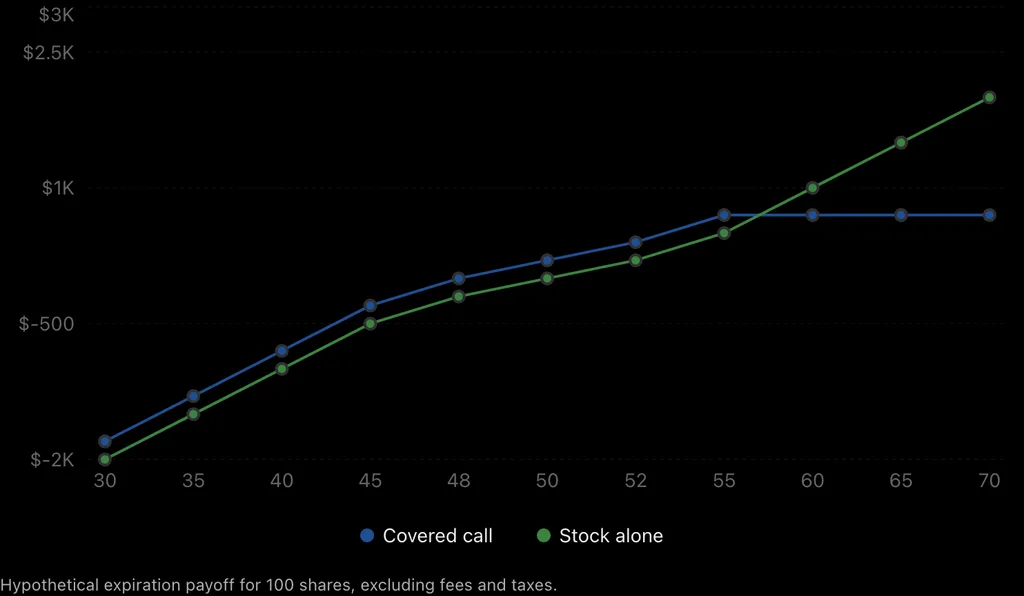
Cash-Secured Puts vs. Covered Calls
Cash-secured puts and covered calls are two popular options strategies.
Both involve selling options to collect premiums, but they begin with different positions.
A covered call involves owning shares and selling a call option against those shares.
A cash-secured put involves selling a put while reserving enough cash to buy shares.
| Feature | Cash-secured put | Covered call |
|---|---|---|
| Starting position | Cash available | Own underlying shares |
| Option sold | Put | Call |
| Main objective | Potentially acquire shares | Generate premium on owned shares |
| Assignment obligation | Buy shares | Sell shares |
| Premium received | Yes | Yes |
| Major risk | Stock falls sharply | Owned stock falls sharply |
| Upside participation | Limited before assignment | Limited above call strike |
Under matching strike and expiration conditions, a cash-secured put and a covered call can have equivalent expiration payoff profiles, although cash flows, dividends, interest, and practical trading considerations can differ.
Related reading: Covered Calls Explained: How They Work, Examples, Profits, and Risks
What Happens When a Cash-Secured Put Is Assigned?
Assignment occurs when the seller of a put option is required to fulfill the contract.
For a standard equity put, this usually means purchasing 100 shares at the strike price for each contract assigned.
For example, if you sold three $50 puts and all three were assigned, you would purchase:
3 × 100 = 300 shares
The total purchase obligation would be:
300 × $50 = $15,000
Assignment can occur before expiration for American-style equity options.
At expiration, standard in-the-money equity options are generally subject to automatic exercise procedures, but exceptions and contrary instructions can affect the outcome.
A stock closing below the strike price is therefore a strong indication of potential assignment, not an absolute guarantee of the final account outcome.
Investors should monitor open positions, particularly near expiration.
Can You Lose Money Selling Cash-Secured Puts?
Yes. Cash-secured puts can produce significant losses.
The word “secured” means that cash is available to fulfill the purchase obligation. It does not mean the investment is protected against losses.
Risk 1: A Major Stock Price Decline
If the underlying company experiences financial difficulties, disappointing earnings, or other negative developments, its share price may fall far below your strike price.
You could be required to buy shares for substantially more than their current market value.
Risk 2: Limited Upside
The most you can earn from the put position at expiration is the premium received.
If the stock doubles, you do not automatically participate in that appreciation.
Risk 3: Capital Is Tied Up
Selling cash-secured puts requires reserving cash.
For example, selling five standard put contracts at a $100 strike creates a gross purchase obligation of $50,000.
That capital may be unavailable for other opportunities while the positions remain open.
Risk 4: Assignment Before Expiration
American-style stock options can be exercised before expiration.
Assignment may therefore occur earlier than expected.
Risk 5: High Premiums Can Signal High Risk
Stocks with unusually high implied volatility may offer attractive premiums.
However, high premiums often reflect the market’s expectation of significant price movement.
A large premium does not guarantee a favorable risk-adjusted return.
Risk 6: Liquidity and Trading Costs
Options with wide bid-ask spreads can be expensive to enter or close.
Transaction fees, slippage, and poor liquidity can reduce returns.
How Much Money Do You Need to Sell Cash-Secured Puts?
For a standard 100-share equity option, the gross purchase obligation is:
Strike price × 100 × Number of contracts
Here are some examples.
| Put strike | One-contract purchase obligation |
|---|---|
| $10 | $1,000 |
| $20 | $2,000 |
| $25 | $2,500 |
| $50 | $5,000 |
| $75 | $7,500 |
| $100 | $10,000 |
Your broker may reduce the cash reserve by the premium received or apply other account-specific rules. Some options also have adjusted contract deliverables, so always verify the actual contract specifications.
Before trading, check the collateral requirement, contract multiplier, and whether the position is fully cash-secured rather than margined.
How to Choose a Strike Price and Expiration Date
There is no single strike price or expiration that works for every investor.
However, several factors deserve attention.
1. Your Desired Purchase Price
Choose a strike at which you would genuinely be willing to own the stock.
Do not select a strike solely because it produces a higher premium.
2. Implied Volatility
Higher implied volatility generally increases option premiums, all else being equal.
It can also indicate greater expected price uncertainty.
3. Delta
Put delta measures how an option’s price responds to changes in the underlying stock price, with other factors held constant.
Traders sometimes use the absolute value of delta as a rough indicator of the likelihood that an option will expire in the money.
However, delta is not an exact probability of assignment or a reliable prediction of the stock’s future price.
4. Time Until Expiration
Short-dated options and longer-dated options behave differently.
Time decay, changes in implied volatility, and sensitivity to stock-price movements can all affect the position.
5. Earnings and Major Announcements
Quarterly earnings, regulatory decisions, and other major events can cause sharp stock-price changes.
Selling a put immediately before an uncertain event may expose the investor to a much larger loss than the premium suggests.
Should You Sell Weekly or Monthly Cash-Secured Puts?
Weekly puts expire sooner and may allow more frequent position adjustments.
Monthly puts typically provide more time premium in total, although they also keep the position open longer.
Neither approach is inherently superior.
Weekly selling can involve more transactions, more frequent assignment decisions, and potentially higher cumulative trading costs.
Monthly selling can provide more flexibility in strike selection and may reduce the need for constant trading.
Comparing premiums alone is insufficient. Investors should also consider downside exposure, collateral requirements, liquidity, taxes, and the possibility of owning the stock.
What Happens After You Get Assigned?
Once assigned, you own the shares and no longer have the original short put obligation.
You can choose to hold the shares, sell them, or consider other strategies.
Some investors sell covered calls after acquiring shares through cash-secured put assignment.
This sequence is often associated with the wheel options strategy.
The general process is:
- Sell a cash-secured put on a stock you would be willing to own.
- If assigned, purchase the shares.
- Sell a covered call against those shares.
- If the call is assigned, sell the shares at the call strike.
- Reassess whether to repeat the process.
Although this approach can generate option premiums, it does not eliminate stock-market risk.
The underlying stock can decline substantially, and covered calls can limit gains during a recovery.
Are Cash-Secured Puts Better Than Limit Orders?
Both strategies can be used by investors who want to acquire shares at a particular price.
A buy limit order generally seeks to purchase shares at the specified limit price or better, subject to execution conditions.
A cash-secured put provides a premium in exchange for a potential obligation to purchase shares at the strike price.
However, the two approaches are not interchangeable.
A stock can briefly trade below your desired purchase price without your put being assigned.
Conversely, an option can be assigned when the stock is worth much less than the strike.
The put seller also accepts option-related risks and obligations that a simple limit order does not create.
Are Cash-Secured Put Premiums Taxable?
In the United States, the tax treatment depends on how the option position ends and on the type of contract.
For many ordinary equity puts:
- If the written put expires worthless: The premium is generally treated as a short-term capital gain.
- If the put is exercised and shares are purchased: The premium generally reduces the tax basis of the acquired shares.
- If the put is bought back to close: The difference between the premium received and the closing cost generally determines the capital gain or loss.
Special rules may apply to certain contracts, traders, and tax situations.
For official guidance, consult IRS Publication 550: Investment Income and Expenses or a qualified tax professional.
Common Cash-Secured Put Mistakes to Avoid
Selling Puts on Stocks You Do Not Want to Own
A premium may look attractive until the stock drops sharply and assignment becomes likely.
Ignoring the Total Purchase Obligation
Selling several contracts can create a much larger obligation than expected.
Always multiply the strike price by the contract multiplier and the number of contracts.
Confusing Premium Income With Guaranteed Profit
Receiving $200 upfront does not mean the entire position is profitable.
The obligation to buy shares may become much more expensive than the premium collected.
Chasing High Implied Volatility
High premiums can accompany high uncertainty.
A single large loss may outweigh premiums collected from several successful trades.
Rolling Without Reassessing the Investment
Rolling a losing put does not erase the original loss.
It creates a new position with new risks, potential rewards, and transaction costs.
Ignoring Diversification
Selling multiple puts on the same stock or highly correlated stocks can create concentrated exposure.
A broad market decline may affect several positions simultaneously.
Frequently Asked Questions About Cash-Secured Puts
Is Selling a Cash-Secured Put Bullish or Bearish?
Selling a cash-secured put generally reflects a neutral-to-bullish outlook.
The investor may expect the stock to remain stable, rise, or experience a modest decline while remaining comfortable purchasing shares at the strike price.
Do You Keep the Premium if a Put Is Assigned?
Yes. The premium received remains yours, but it must be included when calculating the position’s overall profit or loss.
Assignment does not guarantee a profitable trade.
Can You Close a Cash-Secured Put Before Expiration?
Yes. You can generally buy back the put to close the short position, provided the market is available and the trade executes.
The closing cost may be lower or higher than the original premium, producing a gain or loss.
Can You Sell Cash-Secured Puts Every Week?
Weekly put contracts are available on many stocks and ETFs, but availability varies.
Selling weekly puts repeatedly does not guarantee consistent profits or income.
What Happens if the Stock Falls Below the Strike Price?
The put becomes in the money.
Assignment becomes more likely, especially near expiration, and the seller may be required to purchase the shares at the strike price.
What Is the Maximum Profit on a Cash-Secured Put?
For a standard cash-secured put held through expiration, maximum option-strategy profit equals the premium received, before fees and taxes.
What Is the Biggest Risk of Selling Cash-Secured Puts?
The biggest risk is a major decline in the underlying stock.
The seller may have to purchase shares at a strike price significantly above their market value.
Is a Cash-Secured Put Safer Than a Naked Put?
A cash-secured put reserves enough funds to cover the purchase obligation, reducing the need to borrow money or raise cash unexpectedly.
However, both strategies can suffer substantial losses from a decline in the underlying stock.
Cash collateral does not eliminate market risk.
Is Selling Cash-Secured Puts a Good Strategy for Beginners?
The mechanics are relatively straightforward, but the financial risks can be substantial.
Beginners should understand assignment, collateral requirements, option pricing, and potential losses before trading.
Practicing with hypothetical examples can help build familiarity without putting real money at risk.
Final Thoughts: Are Cash-Secured Puts Worth It?
Cash-secured puts can be useful for investors who want to acquire shares at a predetermined price while receiving an option premium.
The strategy may be particularly relevant to investors who have researched a company, are comfortable with its downside risks, and have sufficient cash to purchase the shares.
However, collecting premiums should never be confused with generating guaranteed income.
A single severe stock decline can create losses far greater than the premium received.
Before selling a cash-secured put, ask yourself:
Would I still be comfortable purchasing 100 shares of this stock at the strike price if its market value fell significantly?
If the answer is no, the strategy may not fit your objectives.
For another options strategy that involves collecting premiums on shares you already own, read our Covered Calls Explained guide.
Sources and Further Reading
- Options Industry Council — Cash-Secured Put
- Fidelity — What Is a Cash-Secured Put?
- Fidelity — Cash-Secured Short Put Strategy
- IRS Publication 550 — Investment Income and Expenses
Disclaimer: This article is for educational and informational purposes only and does not constitute personalized financial, investment, tax, or legal advice. Options trading involves significant risk and is not suitable for every investor. All trading examples are hypothetical and exclude fees, taxes, and other transaction costs unless otherwise stated.
