
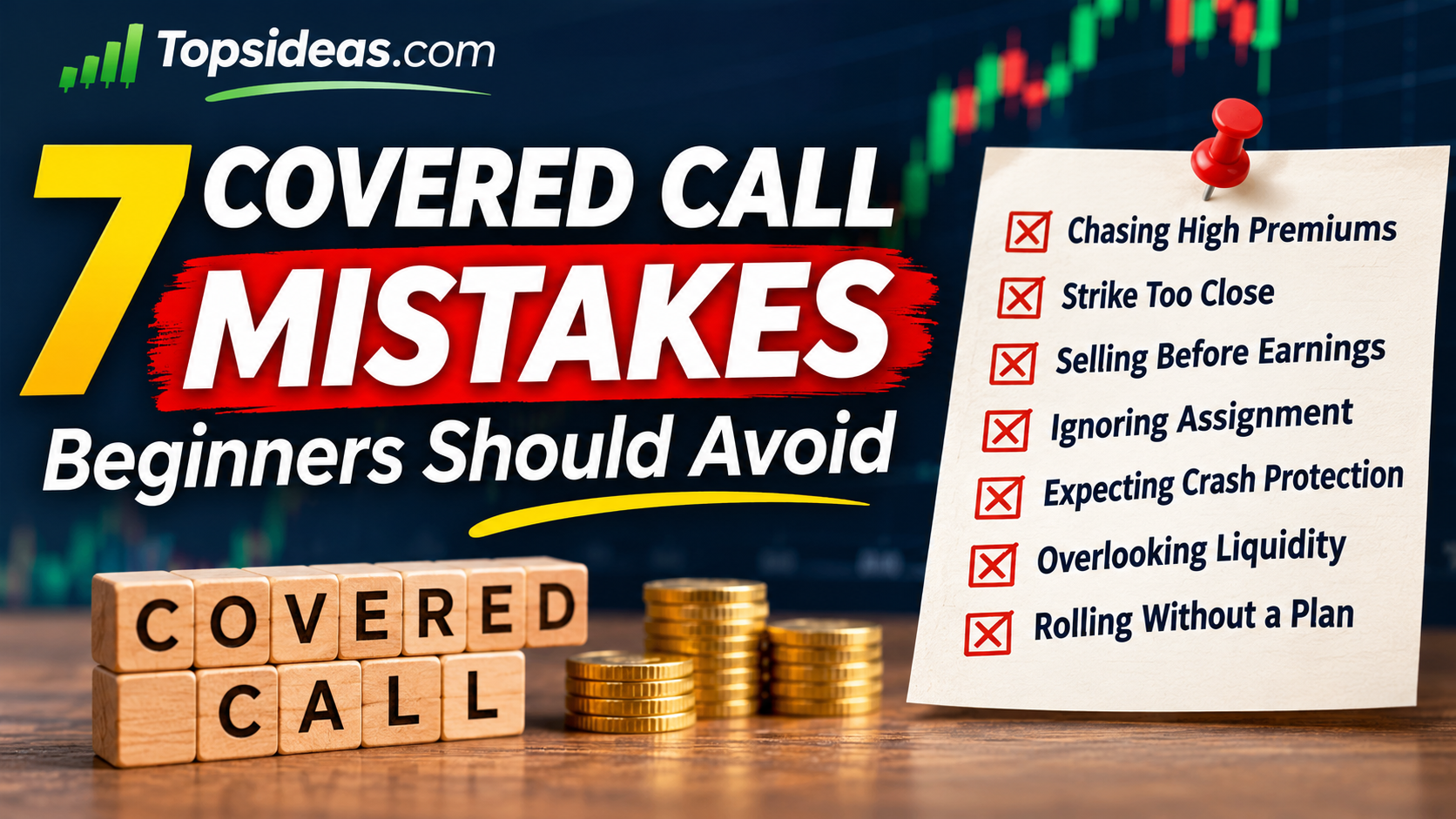

Covered call mistakes can turn a seemingly profitable options strategy into an expensive lesson. Although selling covered calls allows investors to collect premiums on stocks they already own, choosing the wrong strike price, ignoring assignment risk, or chasing high premiums can significantly reduce returns.
But there is a catch: covered calls are not free money, and a high premium does not automatically mean a good trade.
A covered call can limit your profits when a stock rallies, expose you to substantial losses when the stock falls, or result in your shares being sold earlier than expected.
Many beginners focus on how much premium they can collect without considering what happens next.
In this guide, we’ll explore seven common covered call mistakes, show exactly how they affect your profits using hypothetical stock examples, and explain practical ways to avoid them.
What Is a Covered Call?
A covered call is an options strategy in which an investor owns shares of a stock or ETF and sells a call option against those shares.
One standard U.S. equity option contract generally represents 100 shares.
For example, imagine you:
- Own 100 shares of XYZ at $50 per share.
- Sell one covered call with a $55 strike price.
- Receive a premium of $2 per share, or $200 total.
- Agree to sell your shares at $55 if assigned.
If XYZ stays below $55 through expiration and the call expires worthless, you keep the shares and the $200 premium.
If XYZ rises above $55 and your call is assigned, you must sell the 100 shares at $55 each.
Your maximum potential profit on the combined position, assuming the shares were purchased at $50, is:
($55 − $50) × 100 + $200 = $700
However, if the stock falls sharply, the $200 premium provides only limited protection.
For a complete introduction, read our Covered Calls Explained: How They Work, Examples, Profits, and Risks.
Now let’s examine the mistakes that can make this seemingly simple strategy much more complicated.
Mistake #1: Chasing High Premiums Without Understanding the Risk
One of the biggest covered call mistakes is selecting a stock simply because its options offer unusually high premiums.
Imagine two hypothetical stocks:
| Stock A | Stock B | |
|---|---|---|
| Current share price | $50 | $50 |
| Call strike price | $55 | $55 |
| Premium per share | $0.80 | $4.00 |
| Premium for 1 contract | $80 | $400 |
| Premium as % of stock value | 1.6% | 8.0% |
Both options have the same hypothetical expiration date.
At first glance, Stock B appears much more attractive. It pays five times as much premium.
But why?
A higher premium may reflect elevated implied volatility, an upcoming earnings announcement, uncertainty about the company, or expectations of unusually large price movements.
Suppose Stock B falls from $50 to $30 by expiration.
Your stock position loses:
($50 − $30) × 100 = $2,000
After subtracting the $400 premium received, your combined loss is still $1,600.
That $400 premium did not make the investment safe.
How to avoid this mistake
Evaluate the underlying company before evaluating its option premium. Review its financial condition, upcoming events, liquidity, and your willingness to hold the stock during a substantial decline.
High premiums can be appropriate for investors who knowingly accept high volatility. They should never be mistaken for guaranteed income.
Mistake #2: Selling Calls With a Strike Price Too Close to the Stock Price
A lower strike price often generates a larger premium, but it also gives the stock less room to appreciate before the call becomes in the money.
Suppose you purchased 100 shares of XYZ at $50.
You are considering two calls with the same expiration:
| Call A | Call B | |
|---|---|---|
| Strike price | $52 | $60 |
| Premium received | $300 | $80 |
| Maximum combined profit | $500 | $1,080 |
| Upside above purchase price before strike | 4% | 20% |
These premiums are hypothetical.
Call A provides more immediate income, but its lower strike severely restricts the stock’s potential upside.
Now imagine XYZ rises to $65 at expiration.
With Call A, your maximum combined profit is $500.
With Call B, your maximum combined profit is $1,080.
If you had simply held the 100 shares without selling a call, your unrealized stock gain would be $1,500.
The difference illustrates the opportunity cost of covered calls: more premium today can mean giving up substantially more profit tomorrow.
How to avoid this mistake
Choose a strike price based on the price at which you would genuinely be comfortable selling your shares.
A higher out-of-the-money strike may preserve more upside, but it generally provides less premium income.
There is no universally correct strike price. The appropriate choice depends on your outlook, objectives, and tolerance for assignment.
Mistake #3: Selling Covered Calls Immediately Before Earnings
Earnings announcements can produce unusually large stock-price movements.
This creates a dilemma for covered call sellers.
Option premiums may be elevated before earnings because traders expect volatility. But a major move in either direction can create an unfavorable outcome.
Consider a hypothetical company trading at $100 before its earnings announcement.
You own 100 shares and sell a $105 covered call for a $4 premium, collecting $400.
Two possible scenarios illustrate the risk.
Scenario A: The stock jumps to $125.
If your call is assigned at $105, your combined profit is:
($105 − $100) × 100 + $400 = $900
Without the covered call, your stock position would have gained $2,500.
You earned $400 in premium but gave up $1,600 of potential upside compared with holding the shares alone.
Scenario B: The stock crashes to $75.
Your shares lose $2,500 in market value.
After the $400 premium, your combined position loses $2,100.
In both scenarios, the premium does not eliminate the underlying trade-off.
How to avoid this mistake
Check the earnings calendar before selling calls. Consider whether you want to remain exposed to the announcement and whether the strike price reflects your willingness to sell.
Skipping a trade is a reasonable decision when the potential outcomes do not match your investment goals.
Mistake #4: Ignoring Early Assignment and Ex-Dividend Dates
Many beginners assume their shares cannot be called away until expiration.
That assumption is incorrect for standard American-style U.S. stock options.
A call option holder can exercise before expiration, and the seller may be assigned.
Early assignment risk can become particularly important around an ex-dividend date.
Consider this hypothetical situation:
- You own 100 shares of a dividend-paying stock.
- The stock is trading at $52.
- You sold a $50 covered call.
- The upcoming dividend is $0.75 per share.
- The call has only $0.10 per share of remaining time value.
The call is in the money, and the upcoming dividend exceeds its remaining time value.
Under these conditions, early exercise may be economically attractive to a call holder, increasing the covered call seller’s early-assignment risk.
If your shares are called away before the ex-dividend date, you may lose the opportunity to receive that dividend.
Early assignment can also occur for other reasons, and there is no guarantee that an option will or will not be assigned on a particular day.
How to avoid this mistake
Before selling covered calls on dividend-paying stocks:
- Check the next ex-dividend date.
- Monitor whether your call is in the money.
- Examine the option’s remaining time value.
- Decide whether losing the shares before the dividend is acceptable.
If keeping the shares is essential, buying back the short call before assignment is one possible response, although doing so can be expensive.
Mistake #5: Believing Covered Calls Protect You From a Stock Market Crash
Covered calls can reduce your breakeven price slightly, but they do not provide meaningful protection against a severe collapse in the underlying stock.
Let’s return to our original example:
You buy 100 shares at $50 and sell a $55 call for $200.
Your initial stock investment is $5,000.
Your premium income is $200.
Your combined breakeven price at expiration is:
$50 − $2 = $48 per share
Now consider the outcomes at expiration.
| Stock price at expiration | Stock-only profit/loss | Covered call profit/loss |
|---|---|---|
| $65 | +$1,500 | +$700 |
| $55 | +$500 | +$700 |
| $50 | $0 | +$200 |
| $48 | −$200 | $0 |
| $40 | −$1,000 | −$800 |
| $25 | −$2,500 | −$2,300 |
| $0 | −$5,000 | −$4,800 |
Assumptions: 100 shares purchased at $50, one $55-strike call sold for $2 per share, position held through expiration, and no fees, dividends, or taxes. The covered call payoff assumes standard expiration settlement or assignment where applicable.
The covered call provides a $200 improvement relative to owning the stock alone when the stock finishes at or below the strike.
However, it caps your gains when the stock rallies beyond $55.
The maximum theoretical loss is still $4,800 if the stock becomes worthless.
How to avoid this mistake
Treat covered calls primarily as an income and stock-sale strategy, not as insurance against a market crash.
Understand your downside exposure before entering the position, and avoid allocating more capital than you can afford to put at risk.
Mistake #6: Ignoring Liquidity, Bid-Ask Spreads, and Trading Costs
Not every option is easy or inexpensive to trade.
Some stocks have actively traded options with narrow bid-ask spreads. Others have limited trading activity and much wider spreads.
Imagine a call option showing:
- Bid: $1.00
- Ask: $1.40
- Midpoint: $1.20
A beginner might assume they can sell the call for $1.20.
But the midpoint is not a guaranteed execution price.
If the investor sells at the $1.00 bid, the premium collected is $100 per contract rather than the $120 suggested by the midpoint.
If the investor later needs to buy the call back, a wide spread may increase the cost of closing the position.
For example, suppose the option’s market value has fallen, but the current quote is:
- Bid: $0.45
- Ask: $0.75
Buying back the contract at $0.75 costs $75.
If the original sale generated $100, the gross option profit is only $25 before commissions and fees.
Liquidity can materially affect the results of a covered call strategy.
How to avoid this mistake
Review option trading volume, open interest, and the bid-ask spread before placing an order.
Consider using limit orders rather than assuming the displayed midpoint will be available.
Also account for commissions, contract fees, and the possible cost of closing or rolling a position.
Mistake #7: Rolling Losing Covered Calls Without Calculating the Real Cost
Rolling a covered call means buying back an existing short call and selling another call, often with a later expiration date or a different strike price.
Rolling can be useful, but it is not a guaranteed way to repair an unfavorable position.
Suppose you own 100 shares purchased at $50.
You sell a $55 covered call for $200.
The stock subsequently rallies to $62, and the short call now costs $850 to buy back.
You decide to roll:
| Transaction | Cash flow |
|---|---|
| Sell original covered call | +$200 |
| Buy back original call | −$850 |
| Sell new $65 covered call | +$500 |
| Net option cash flow | −$150 |
Although the new call generates $500 in premium, your total option transactions have produced a net debit of $150.
Your new position may offer more upside because the strike has increased to $65, but you have also extended your obligation and exposure to the stock.
If the stock falls sharply after the roll, the higher strike will not prevent losses on the shares.
Rolling does not erase the cost of buying back the original call.
How to avoid this mistake
Before rolling, calculate the combined cash flows from the original option and the proposed replacement.
Ask yourself whether you would willingly enter the new position if you did not already own the old one.
Sometimes accepting assignment is more consistent with the original plan than paying to maintain the stock position.
Covered Call Mistakes: Quick Comparison
| Common mistake | Main risk | Practical precaution |
|---|---|---|
| Chasing high premiums | Large underlying stock losses | Evaluate the stock before the premium |
| Choosing a low strike | Giving up substantial upside | Select an acceptable sale price |
| Ignoring earnings | Large overnight price changes | Check upcoming announcements |
| Ignoring early assignment | Unexpected sale of shares | Monitor expiration and ex-dividend dates |
| Assuming downside protection | Major losses during a stock decline | Calculate maximum downside exposure |
| Ignoring liquidity | Poor execution and higher costs | Check bid-ask spreads and volume |
| Rolling without calculating | Hidden costs and extended exposure | Track cumulative option cash flows |
How to Evaluate a Covered Call Before Selling It
Rather than focusing exclusively on premium income, consider the entire position.
For a covered call involving 100 shares, the basic expiration calculations are:
Premium collected
Option premium per share × 100
Maximum combined profit
(Strike price − original stock purchase price) × 100 + premium collected
Breakeven stock price
Original stock purchase price − premium per share
Maximum theoretical loss
Original stock purchase cost − premium collected
These formulas assume a conventional covered call with the stock and short call held through expiration, and exclude trading costs, dividends, and taxes.
An investor should also consider the following questions:
- Would I be comfortable holding this stock if it declined significantly?
- Am I willing to sell my shares at the strike price?
- Are earnings or dividends approaching?
- Is the option sufficiently liquid?
- What is my plan if the stock rises, falls, or remains flat?
- How would assignment affect my taxes or long-term investment plan?
Answering these questions can help investors evaluate whether a particular covered call fits their objectives.
Are Covered Calls Worth It for Beginners?
Covered calls can be useful for investors who already own stocks they are willing to sell at a predetermined price.
They can generate option premiums and provide a modest reduction in the combined position’s breakeven price.
However, they also introduce new obligations and decisions.
The investor must understand assignment, expiration, strike selection, opportunity cost, and the possibility of substantial losses in the underlying shares.
For beginners, the most important lesson is that a covered call should be evaluated as one combined stock-and-option position, not simply as a way to collect a premium.
Frequently Asked Questions
What is the biggest mistake when selling covered calls?
One of the most damaging mistakes is choosing a stock based solely on its high option premium. The premium may be attractive because the underlying shares carry substantial risk. A sharp stock decline can easily exceed the income collected.
Can you lose money selling covered calls?
Yes. If the underlying stock declines enough, the combined position can lose money despite the premium received. The premium provides only a limited downside cushion.
Can covered calls lose more than the premium received?
Yes. In a standard fully covered call, the stock can lose nearly its entire value. The premium reduces the overall loss but does not eliminate it.
What happens if my covered call expires in the money?
An in-the-money short equity call is generally subject to exercise and assignment at expiration, which means your shares may be sold at the strike price. Standard exercise-by-exception procedures generally apply to options at least $0.01 in the money, subject to exceptions and holder instructions.
Is it better to sell weekly or monthly covered calls?
Neither is automatically better. Weekly calls require more frequent decisions and can expose the investor to short-term price movements. Longer-dated calls may offer a larger total premium but extend the time during which upside is capped. The appropriate expiration depends on the investor’s objectives and risk tolerance.
Should I roll a covered call that is in the money?
Not necessarily. Rolling can change the strike price and expiration date, but it may require a net debit or extend the investment’s risk. Compare the total costs and benefits with simply accepting assignment.
Can I avoid assignment by choosing a far out-of-the-money strike?
A higher strike generally reduces the likelihood of assignment, all else equal, but it does not eliminate the risk. American-style equity options may be exercised before expiration.
Final Thoughts
Covered calls are relatively straightforward to construct, but they require more planning than simply owning shares.
The seven mistakes discussed here share a common theme: focusing on the premium while overlooking the underlying stock, the obligation to sell, and the full range of possible outcomes.
Investors who understand these trade-offs can make more informed decisions about whether, when, and how to sell covered calls.
For more educational examples, explore our complete covered calls guide or learn how cash-secured puts work. Both strategies involve selling options, but their obligations and investment objectives differ.
Educational Disclaimer
This article is for informational and educational purposes only and does not constitute personalized financial, investment, tax, or legal advice. Options trading involves risk and is not suitable for every investor. All numerical examples are hypothetical and exclude commissions, fees, dividends, and taxes unless otherwise noted. Investors should review the OCC’s Characteristics and Risks of Standardized Options before trading.
References and Further Reading
- Options Industry Council — Covered Call (Buy/Write)
- Options Industry Council — Options Assignment
- Fidelity — What Is a Covered Call?
- Fidelity — Dividends and Options Assignment Risk
- Cboe — Dividend and Early Assignment Risk
